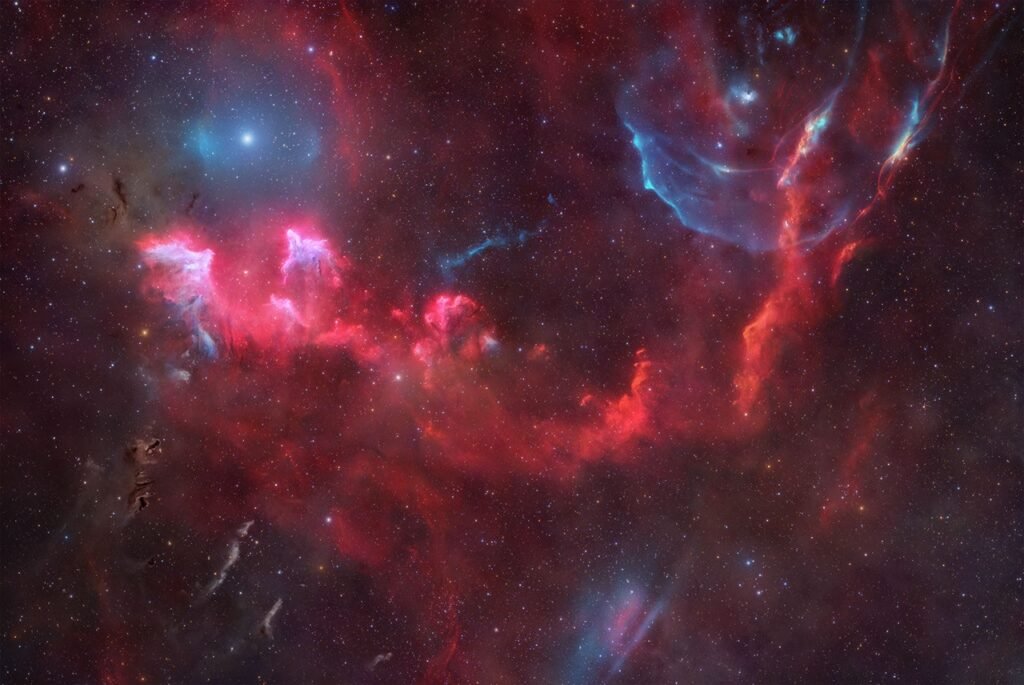
On October 21, 2026, NASA’s Astronomy Picture of the Day featured three faint nebulas hidden in the Cassiopeia constellation, revealed after 100 hours of observation and a special oxygen filter.
IC 59 and IC 63, known as the original Ghosts of Cassiopeia, haunt the region near the multi-star system γ Cassiopeia. Energetic light from γ Cassiopeia causes the hydrogen gas in IC 59 and 63 to glow red, while their dust reflects and scatters some blue-ish white starlight.
Newly discovered Objects 1, 2, and 3 appear as blue phantoms, revealing the presence of ionized oxygen. But ionized by what? Like at the bow of a speeding boat, γ Cassiopeia may be piling up material as the system moves through interstellar gas and dust.
It follows that Object 3 may be the compressed and heated oxygen of that bow shock. Object 1 could be a planetary nebula if a central white dwarf is identified. The origins of these astronomical apparitions remain a mystery to be solved.
The image is credited to Louis Leroux-Géré, Thibault Rouillé, Vincent Martin, and Cédric de Decker of Starfront Observatories. The APOD service is provided by ASD at NASA / GSFC, NASA Science Activation, and Michigan Tech.