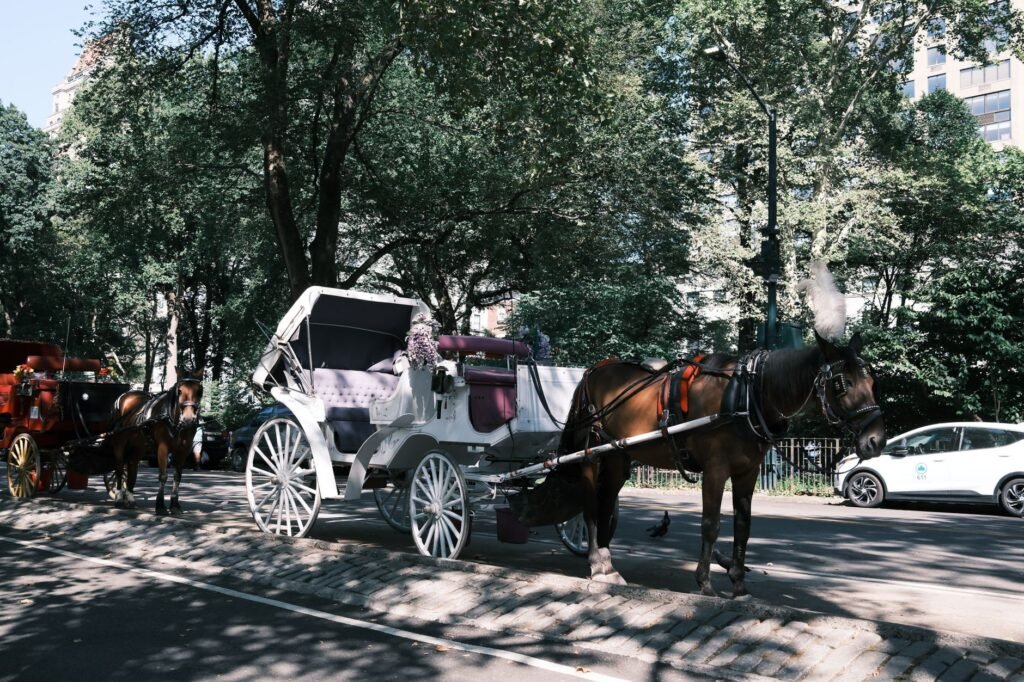
The horse-drawn carriages that have cruised through Central Park for more than 150 years are set to be banished soon from New York City, ending an iconic tradition beloved by tourists but long opposed by animal welfare activists.
For the carriage drivers, it’s unclear what comes next.
“No one can come up with an appropriate answer because there is none,” said Alexus Lawson, a 28-year-old carriage driver from Queens who grew up with horses and has worked as a riding instructor. Now, she worries about what would become of 7-year-old Starlight and her other horses. “Without a job, how can I take care of my horses?”
The New York City Council is expected to pass a bill Thursday that would ban horse-drawn carriage rides by June 2028, pulling back the reins after the death of a teenage tourist last spring spurred the latest call to end the rides after decades of opposition from activists.
But the one question that has come up time and again — what to do with drivers whose jobs would be eliminated — remains largely unanswered.
The legislation requires Mayor Zohran Mamdani’s office to develop a plan by next April to help the more than 150 remaining drivers find other work. That would include referrals for job openings in the city’s transit, hospitality and taxi industries, as well as career counseling. It also would anticipate the administration considering some form of compensation for industry workers.
City Hall is working on a detailed plan for the transition of the workforce and has started discussions on potential compensation, a spokesperson for the mayor said. And Mamdani himself has said government has a “civic responsibility to ensure that we are not leaving anybody out to dry.”
Medet Fidan, a former cab driver who traded his steering wheel for a set of reins after ride sharing apps upended the taxi industry, said he felt like he was being targeted.
“I think the city is leaving us a big mess,” said Fidan, 56, who has been driving a carriage for 15 years. “We’re going to lose our businesses, we’re going to lose our jobs, we’re going to lose our livelihoods.”
Council Speaker Julie Menin “will remain engaged in the transition process,” a spokesperson said, adding that the legislation seeks to address the longstanding question of what happens to displaced carriage drivers by setting a firm deadline for City Hall to act.
The union representing the drivers has vowed to file a legal challenge “the minute the ink dries” on the legislation.
Mamdani’s two immediate predecessors as mayor had both called to end the industry, but neither succeeded.
Former Mayor Bill de Blasio campaigned on ending the rides on day one of his administration but the effort wilted amid a backlash from unions and a big media blitz involving actor Liam Neeson. Eric Adams, the mayor just before Mamdani, floated a ban late in his term but the proposal went nowhere.
The latest push began in June after an 18-year-old Indian tourist, Romanch Mahajan, died after jumping from a runaway carriage during a ride. That appeared to be the first fatality involving a horse carriage in Central Park since the rides began.
Mahajan’s family has personally appealed to the city to end the rides, offering tearful testimony that they thought the rides were safe. His father, Deepak Mahajan, told lawmakers that his son jumped from the carriage to help his mother after she was thrown out of her seat after the horse suddenly bolted.
Carriage drivers have expressed sympathy for Mahajan and his family but argue that they are being unfairly targeted because of a single accident.
“It does nothing for alternate employment, for the continuation of our businesses,” said Christina Hansen, a longtime carriage driver and industry spokesperson. “Who’s going to pay my rent while I’m looking for a job.”